Astronomers using the James Webb Space Telescope say the dust left by a famous exploded star holds clues that its inner layers mixed together shortly before it blew up. NASA released the findings on Nov. 23. The study appears in The Astrophysical Journal Letters.
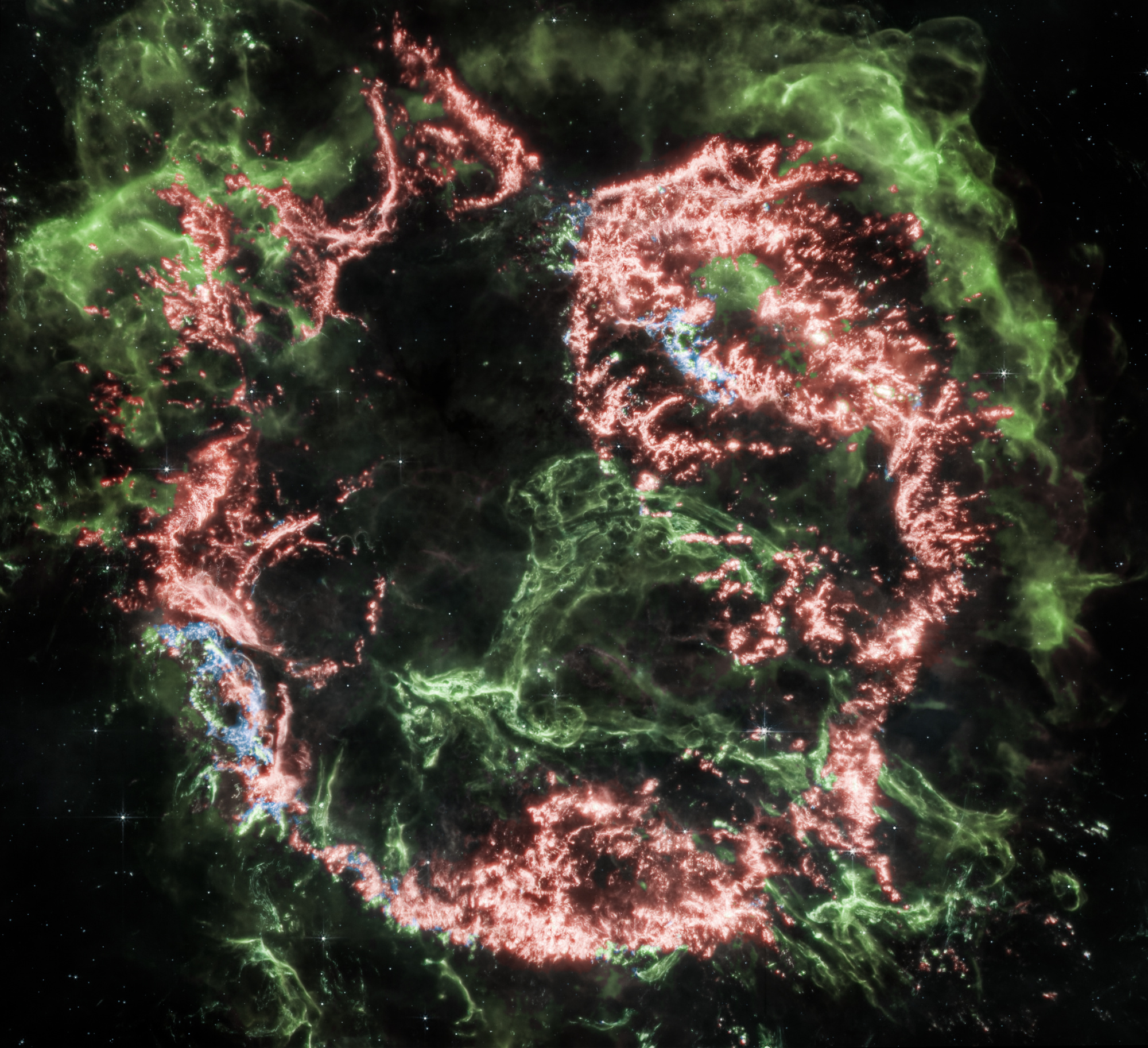
The team used Webb’s mid-infrared instrument, MIRI, to study Cassiopeia A, the expanding cloud left by a massive star that exploded centuries ago. Webb picked out clumps of dust about the size of our solar system. Across much of the cloud, the dust showed signs of a “shell merger,” when the star’s oxygen-burning and carbon-burning layers mix. X-ray data from NASA’s Chandra and Japan’s XRISM telescopes support the idea that this happened very shortly before the explosion, possibly within hours, the researchers say.
The team looked closely at three regions. One was mostly silica dust and another mostly carbon dust. The third, nicknamed the “Green Monster,” is rich in magnesium silicates and came from material the star threw off before it exploded. Tea Temim of Columbia University led the study, with Dan Milisavljevic of Purdue University among the co-authors.
Status: Reported (researchers’ findings as released by NASA). Sources: NASA Science; The Astrophysical Journal Letters (DOI 10.3847/2041-8213/aea901). Updated Nov. 24, 2026, 6 a.m. CT.
Photo: Cassiopeia A seen in mid-infrared light by Webb’s MIRI instrument. NASA, ESA, CSA, STScI, Tea Temim (Columbia University), Rick Arendt (UMBC), Dan Milisavljevic (Purdue University); image processing: Joseph DePasquale (STScI) (NASA media guidelines, credit required).

Subscribe to continue reading
Become a paid subscriber to get access to the rest of this post and other exclusive content.